
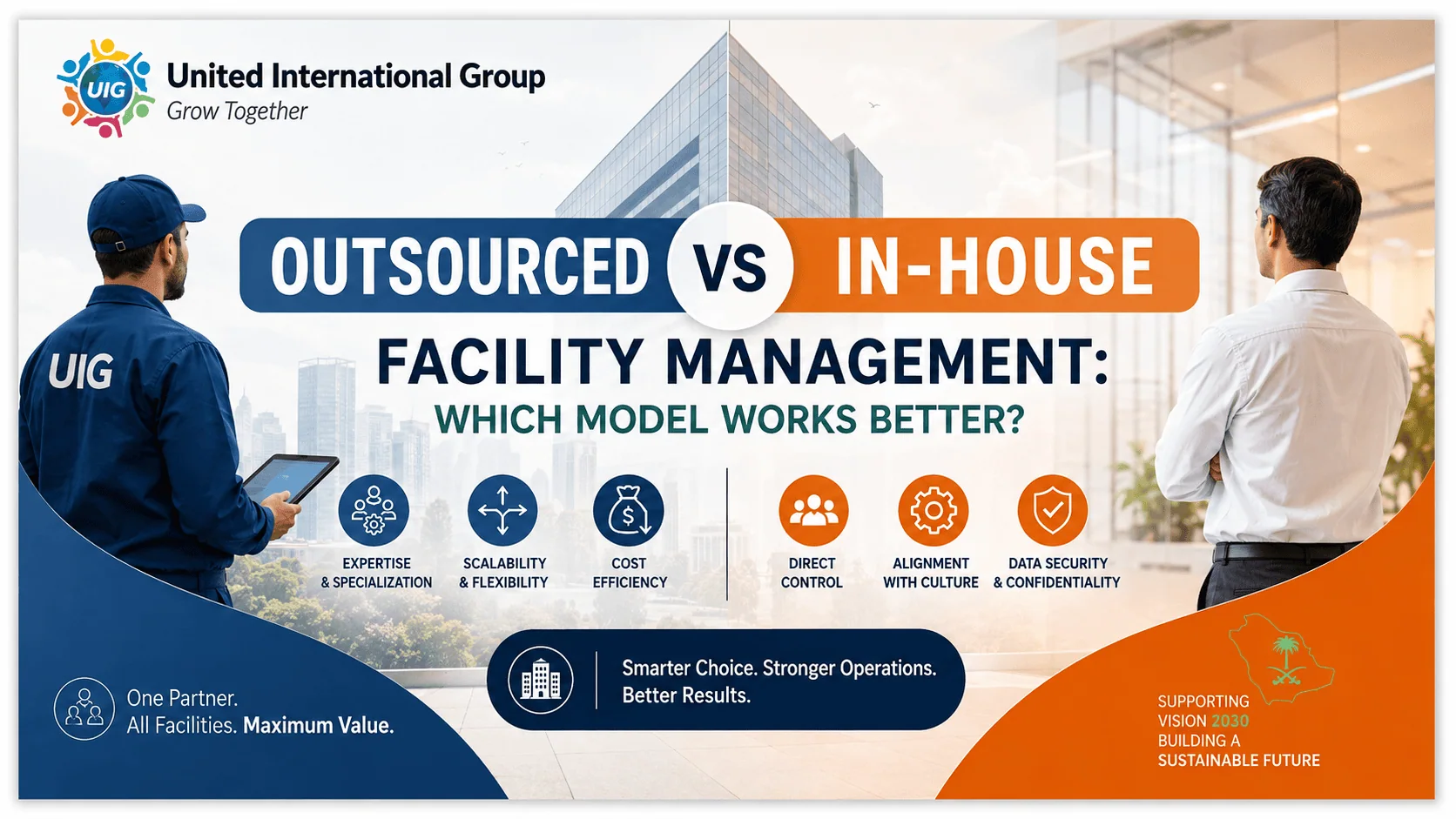
Every facilities director eventually asks the same question: build a team, or bring in a partner who already has one? The outsourced vs in-house FM decision affects your budget, your compliance exposure, and how fast problems actually get fixed when something breaks at 2 a.m.
There’s no universal right answer. A 12-branch retail chain in Riyadh has different needs than a single manufacturing plant in Jubail. What matters is understanding the real trade-offs — not the marketing version of either model — so the decision fits your building, your risk tolerance, and your growth plans.
This guide breaks down both models honestly, including where in-house still makes sense, before looking at how integrated facility management is actually applied across Saudi Arabia today.
What Is In-House Facility Management?
In-house facility management means your organization directly employs the technicians, supervisors, and support staff who maintain your buildings. You control hiring, training, schedules, and equipment. The team reports to you, not to an external contract.
This model works well when:
- You operate a single site with predictable, specialized maintenance needs
- Facilities work is closely tied to your core operations (a hospital’s medical gas systems, for example)
- You have the internal capacity to manage HR, procurement, and compliance for a technical workforce
The trade-off is scale. Every skill set — HVAC, electrical, plumbing, fire safety, cleaning, security — needs its own hire, its own training budget, and its own backup plan when someone quits.
What Is Outsourced Facility Management?
Outsourced facility management shifts day-to-day operations to a third-party provider under a service agreement. The provider brings its own trained workforce, equipment, vendor network, and reporting systems. You define the service levels; they deliver against them.
Most providers offer this through two tracks:
- Hard FM — building-critical systems like HVAC, electrical, plumbing, and fire safety
- Soft FM — cleaning, landscaping, security, pest control, and waste management
Bundled together, this is usually called Integrated Facility Management (IFM) — a single point of accountability instead of a dozen separate vendor contracts.
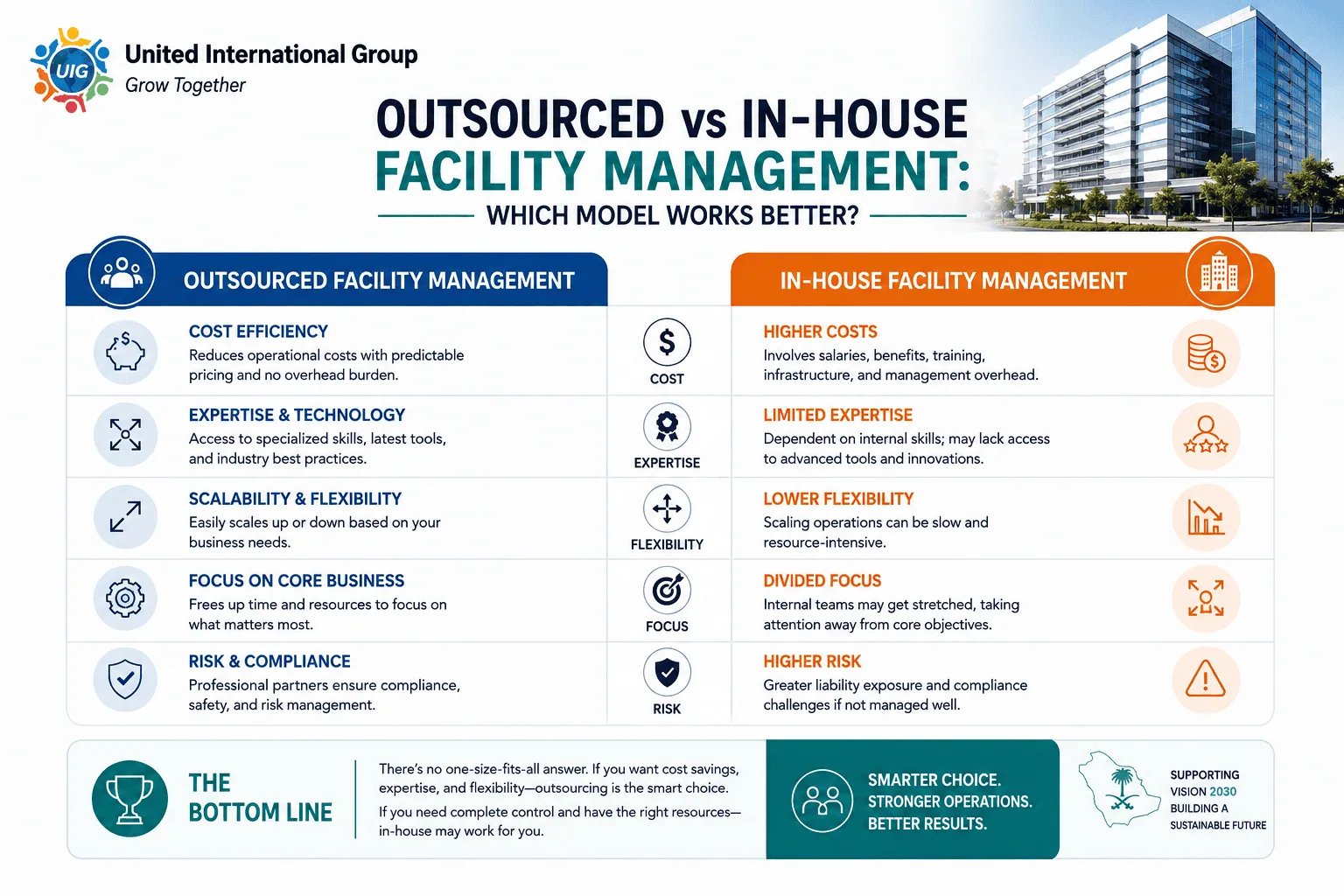
Outsourced vs In-House Facility Management: Side-by-Side Comparison
| Factor | In-House FM | Outsourced FM |
| Upfront cost | High — hiring, training, tools, vehicles | Lower — provider already has the workforce and equipment |
| Cost predictability | Variable — overtime, turnover, emergency repairs | Fixed under a service contract, with clear SLAs |
| Speed to scale | Slow — recruitment and onboarding take months | Fast — provider adds coverage as your portfolio grows |
| Access to specialists | Limited to what you can afford to hire full-time | Broad — providers maintain multi-disciplinary teams |
| Compliance and audits | Falls entirely on your internal team | Shared with a provider who tracks it across many sites |
| Direct oversight | Full, day-to-day control | Governed through SLAs and regular reporting |
| Best suited for | Single-site, highly specialized operations | Multi-site portfolios, retail, healthcare, industrial, commercial real estate |
A 2023 industry estimate from IFMA put global outsourced FM spending growth at roughly 6-8% annually, driven largely by organizations consolidating vendors into single IFM contracts to reduce administrative overhead.
Where In-House Still Wins
Outsourcing isn’t automatically better. In-house FM tends to outperform when:
- The site is highly specialized. A pharmaceutical cleanroom or a data center with unique environmental controls often needs staff who live and breathe that one system, not a generalist FM rotation.
- Response time is measured in minutes, not hours. Some critical-operations sites can’t tolerate any handoff delay, even a well-managed one.
- The organization is small enough that one multi-skilled caretaker covers everything. Below a certain size, outsourcing overhead isn’t worth it.
The honest answer is that scale is usually the deciding factor. Below a certain portfolio size, in-house is leaner. Above it, the coordination cost of running your own FM department starts to outweigh the savings.
Why Multi-Site Organizations in Saudi Arabia Lean Toward Outsourcing
Saudi Arabia’s commercial and industrial growth continues alongside the Kingdom’s broader Saudi Vision 2030 transformation agenda.— from Riyadh’s expanding office and retail footprint to Jeddah’s logistics corridors and Jubail’s industrial base — has pushed many organizations past the point where in-house FM scales efficiently.
A facility manager overseeing five branches in Riyadh and two in Jeddah doesn’t just need more staff — they need consistent service standards across cities, unified reporting, and a single vendor who’s accountable end-to-end rather than five separate local contractors with five different quality bars.
This is where integrated facility management earns its place: one contract, one set of SLAs, one dashboard for compliance and asset history, instead of a patchwork of local suppliers each managing their own slice of the building.
Practical example: A retail group operating stores across Riyadh, Jeddah, and Dammam typically saves significant coordination time by moving from separate local cleaning, security, and maintenance vendors per city to one IFM provider managing all three under a shared SLA — because incident reports, preventive maintenance schedules, and compliance documentation live in one system instead of three.
Cost: What Actually Gets Compared
Cost comparisons between outsourced and in-house FM often go wrong because they only compare salaries against contract fees. A fuller comparison includes:
- Recruitment and training costs for in-house staff
- Turnover and coverage gaps when technicians leave
- Equipment purchase versus provider-supplied tools
- Emergency repair markups versus fixed-fee contracts
- Compliance and audit preparation time
Outsourced FM tends to convert variable, unpredictable costs into a fixed, budgetable line item. In-house FM tends to offer lower cost per hour of labor but higher exposure to gaps, overtime, and specialist shortages.
How to Decide Which Model Fits Your Facility
Ask these questions before choosing:
- How many sites do you operate, and in how many cities? More than two or three locations usually tips the balance toward outsourcing.
- How specialized is your equipment? Highly proprietary systems may need dedicated in-house expertise.
- Can your team absorb HR and compliance overhead for technical staff? If not, that’s a hidden cost of staying in-house.
- Do you need Hard FM, Soft FM, or both? Bundling both under one IFM provider usually reduces coordination cost versus managing them separately.
- What’s your tolerance for variable costs? Fixed-fee contracts suit organizations that need predictable budgeting.
Since 2011, UIG has worked through exactly this decision with clients across Saudi Arabia — helping some transition fully to outsourced IFM, and helping others build hybrid models where specialized in-house staff work alongside an outsourced soft FM team. There’s no one-size answer; there’s a right fit for your portfolio.
Conclusion
The choice between outsourced and in-house facility management isn’t about which model is universally better — it’s about which one fits the size, complexity, and geographic spread of your operation. Single-site, highly specialized facilities often still do well running things in-house. Multi-site portfolios across cities like Riyadh, Jeddah, and Jubail generally get more consistency and cost predictability from an integrated outsourced model.
UIG has been delivering integrated facility management services across Saudi Arabia since 2011, working with clients to design the FM model that actually matches their operations — whether that’s full outsourcing, a hybrid setup, or a phased transition from an internal team. Contact UIG to discuss which approach fits your facility.
Frequently Asked Questions
Q. What is the main difference between outsourced and in-house facility management?
In-house FM means your organization directly employs and manages the maintenance team. Outsourced FM means a third-party provider delivers those services under a contract with defined service levels.
Q. Is outsourced facility management cheaper than in-house?
Usually yes for multi-site or mid-to-large operations, once you factor in recruitment, training, turnover, and equipment costs — not just hourly wages. Single-site, highly specialized operations sometimes find in-house more cost-effective.
Q. What is Integrated Facility Management (IFM)?
IFM bundles Hard FM (HVAC, electrical, plumbing, fire safety) and Soft FM (cleaning, security, landscaping, pest control) under one provider and one contract, instead of managing separate vendors for each service.
Q. When should a company outsource facility management?
Outsourcing tends to make sense once an organization operates multiple sites, needs specialist coverage it can’t justify hiring full-time, or wants predictable, fixed FM costs instead of variable in-house overhead.
Q. Can a company use a hybrid model of both in-house and outsourced FM?
Yes. Many organizations keep highly specialized or safety-critical roles in-house while outsourcing broader Hard FM and Soft FM services to a provider — this is common in healthcare and industrial facilities.
Q. Does outsourcing facility management mean losing control over quality?
Not if the contract is structured properly. Service Level Agreements (SLAs), regular reporting, and defined KPIs give you measurable oversight — often more structured than informal in-house tracking.
Q. What industries benefit most from outsourced facility management?
Retail chains, healthcare networks, commercial real estate, and industrial facilities with multiple sites typically see the biggest gains, since outsourcing scales more efficiently than building an internal FM department at each location.