If your building’s AC fails in July, you don’t get a grace period. Saudi officials have put the Kingdom’s cooling load at around 70% of total electricity consumption, and most of that draw happens in commercial and residential buildings that can’t afford downtime. A solid HVAC maintenance checklist is what separates a system that quietly does its job for years from one that fails on the hottest day of the year, in front of tenants, guests, or a production line.
This guide breaks down what a proper HVAC maintenance checklist covers for buildings in Saudi Arabia’s climate, how often to run it, what it costs, and how to choose a maintenance partner who won’t leave you stuck mid-summer.
Why HVAC Maintenance Works Differently in Saudi Arabia
Saudi Arabia’s climate is harder on HVAC equipment than almost anywhere else. Summer temperatures above 45°C push compressors and condensers to run near-continuously for months. Dust and sandstorms clog filters and coils faster than in temperate climates, and in high-dust regions filters need checking every two to three weeks, not once a quarter. Coastal cities like Jeddah add humidity and salt air, which corrode coils and electrical components over time.
Saudi Arabia’s building code applies to the design, operation, and maintenance of buildings across the Kingdom, including mechanical and HVAC systems, and places that responsibility on the building owner. That’s a maintenance obligation tied to occupancy and safety compliance, whether the building sits in Riyadh, Jeddah, Jubail, or anywhere else in the Kingdom.
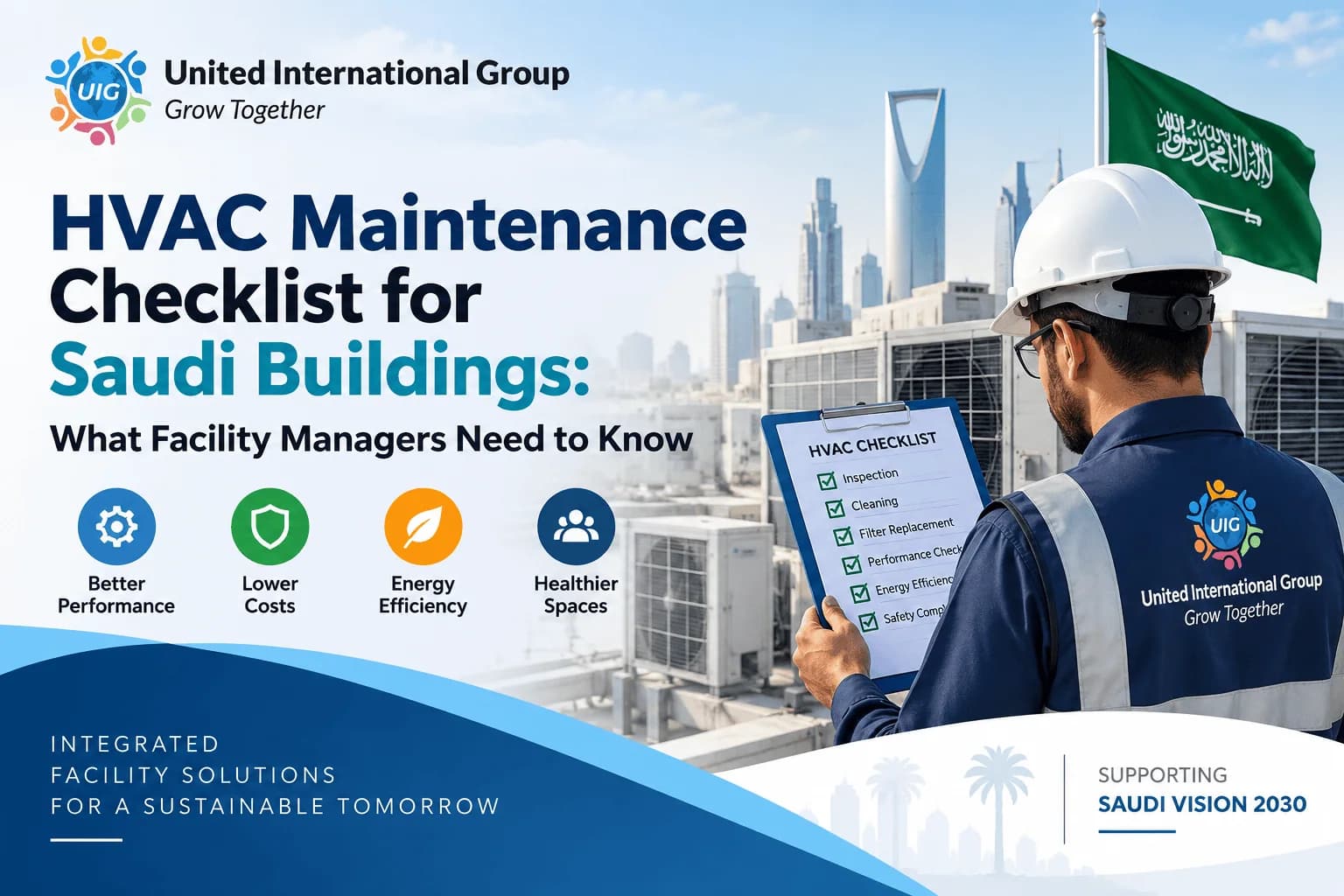
The Complete HVAC Maintenance Checklist for Saudi Buildings
An HVAC maintenance checklist is a structured list of inspection, cleaning, and testing tasks performed on a set schedule to keep heating, ventilation, and air conditioning systems running safely and efficiently. In Saudi Arabia’s climate, that schedule needs to be tighter than in most countries.
Monthly HVAC Maintenance Check
- Inspect and clean or replace air filters (every 2–4 weeks in high-dust areas)
- Check condensate drain lines for blockages
- Listen for unusual noise or vibration from indoor and outdoor units
- Confirm thermostat and control settings match occupancy schedules
Quarterly HVAC Maintenance and Cleaning
- Clean evaporator and condenser coils
- Check refrigerant levels and inspect for leaks
- Inspect belts, pulleys, and bearings for wear
- Test electrical connections and capacitors
- Inspect ductwork for dust buildup and leaks — this is where HVAC maintenance and duct cleaning becomes essential given how much dust infiltrates Saudi buildings year-round
Before Summer: Annual HVAC Maintenance Check
- Full system performance test ahead of peak load
- Deep-clean coils and ducts
- Calibrate thermostats and sensors
- Check insulation on refrigerant lines
- Verify backup or redundant cooling capacity where it matters most: hospitals, data centers, malls
Before Winter: Off-Season HVAC Maintenance
- Inspect heating elements and heat pumps
- Clean and seal ductwork before it sits idle
- Check for corrosion caused by summer humidity
- Schedule major repairs while cooling demand is lower

HVAC Maintenance and Repair: Where One Ends and the Other Begins
HVAC maintenance and repair aren’t the same service, and treating them as interchangeable is how buildings end up with the same failure twice.
Maintenance is preventive: scheduled inspections, cleaning, and small adjustments that stop failures before they start. Repair is reactive: fixing something that has already broken, whether that’s a failed compressor, a refrigerant leak, or an electrical fault.
HVAC maintenance best practices catch most of what would otherwise become a repair call. A well-run preventive maintenance program generally means fewer emergency repairs, shorter equipment downtime, and equipment that reaches or exceeds its expected service life.
That’s one of the clearest benefits of HVAC maintenance done on a schedule, rather than only when something stops working. Many facility teams also benchmark their internal schedules against ASHRAE’s commercial HVAC maintenance guidelines when building out a contract’s scope.
HVAC Maintenance Cost in Saudi Arabia
HVAC maintenance cost in Saudi Arabia depends on building size, system type, unit count, and whether you’re paying per visit or under a contract. As a general pattern:
- Reactive, one-off repairs cost more per incident than routine maintenance, and tend to happen during peak summer load, when they’re hardest to schedule around.
- A maintenance contract spreads cost across the year and usually works out lower than the same volume of reactive repairs, since problems get caught while they’re still cheap to fix.
- Annual HVAC maintenance cost scales with unit count, ductwork complexity, and system age; older systems generally need more frequent attention.
| Cost Driver | Impact on Maintenance Cost |
| Building size / unit count | More units raise total contract cost, but lower the cost per unit |
| System type | Central and VRF systems typically cost more per visit than standalone split units |
| System age | Older systems need more frequent, more involved servicing |
| Contract vs. pay-per-visit | A contract typically costs less over a year than the same repairs paid individually |
Because pricing depends on your building’s actual systems, exact figures should come from a site assessment rather than an industry average. A maintenance quote from UIG gives you a cost breakdown based on your equipment, not a generic estimate.
HVAC Maintenance Agreement vs. One-Off Repairs
An HVAC maintenance agreement is a contract that locks in scheduled servicing, usually monthly filter checks plus quarterly and seasonal deep maintenance, for a fixed period, typically 12 months.
A solid HVAC maintenance contract should specify:
- Exact scope: what’s inspected, cleaned, and tested at each visit
- Response time for emergency calls
- Parts and labor coverage for common wear items
- Reporting: a maintenance log you can reference for compliance and audits
The main advantage over one-off repairs is predictability. You know what’s covered, what a visit costs, and when it happens, instead of discovering a problem only after the system has already failed.
Choosing an HVAC Maintenance Company in Saudi Arabia
Not every HVAC maintenance company in Saudi Arabia can handle commercial-scale systems in Riyadh, Jeddah, or Jubail. Before signing, check for:
- Certified technicians trained on your system type (split, central, or VRF)
- A track record with buildings like yours: offices, retail, hospitality, industrial
- Working knowledge of the Saudi Building Code’s mechanical requirements
- Response times matched to your risk tolerance; a hospital and a warehouse don’t need the same SLA
- Transparent reporting, not just a signature on a visit sheet
United International Group has delivered integrated facility management services, including MEP and HVAC maintenance, across Saudi Arabia since 2011, with 425+ completed projects for corporate clients in Riyadh, Jeddah, Jubail, and beyond.
If you’re looking for an HVAC maintenance company that treats maintenance as a scheduled discipline rather than a callback service, that’s where UIG’s facility management team comes in.
Conclusion
A working HVAC maintenance checklist isn’t a formality. In a climate where cooling accounts for most of a building’s electricity use, it’s what keeps tenants comfortable, equipment protected, and operating costs predictable. Whether you manage a single commercial tower in Riyadh or a portfolio spread across Jeddah and Jubail, the difference between a maintenance contract and reactive repairs usually shows up as one large, avoidable bill.
UIG has run HVAC and MEP maintenance programs across Saudi Arabia since 2011, completing 425+ facility management projects for corporate clients across the Kingdom.
Talk to UIG
Need a Maintenance Plan Built Around Your Building?
UIG has managed HVAC and MEP maintenance for 425+ projects across Saudi Arabia since 2011. Get a maintenance plan scoped to your building’s actual systems — not a generic package.
Frequently Asked Questions
Q. What is HVAC maintenance?
HVAC maintenance is the routine inspection, cleaning, and servicing of heating, ventilation, and air conditioning equipment to keep it running safely and efficiently. It includes filter changes, coil cleaning, refrigerant checks, and electrical testing, done on a set schedule rather than only after something breaks.
Q. What’s included in an HVAC maintenance checklist?
A standard checklist covers filter inspection, coil cleaning, refrigerant level checks, condensate drain clearing, electrical and belt inspection, thermostat calibration, and ductwork review. In Saudi Arabia, filter and duct cleaning need to happen more often because of dust.
Q. How often should HVAC systems be serviced in Saudi Arabia?
Most commercial systems need monthly filter checks, quarterly maintenance visits, and a full inspection before the summer peak. The Saudi Building Code requires mechanical systems, including HVAC, to stay in proper operating condition for as long as they’re in use.
Q. What is the difference between AC and HVAC?
AC only cools the air. HVAC covers the full system: heating, cooling, and air circulation working together to control a building’s indoor climate.
Q. What are the three main types of HVAC systems?
Split systems, with separate indoor and outdoor units; packaged or central systems, with components in one unit or a centralized plant; and VRF (variable refrigerant flow) systems, common in larger Saudi commercial buildings for zone-by-zone efficiency.
Q. What is the $5,000 rule for HVAC?
It’s a repair-versus-replace rule of thumb: multiply the unit’s age in years by the repair cost estimate. If the result tops roughly 5,000, replacement usually makes more sense than repair. Treat it as a guideline and confirm it against your actual equipment condition.
Q. What skills should a qualified HVAC technician have?
Electrical and mechanical troubleshooting, certified refrigerant handling, the ability to read system diagrams, working knowledge of local safety and code compliance, and clear reporting to facility managers.
Q. What’s included in HVAC preventive maintenance?
Scheduled inspections, cleaning of filters and coils, lubrication of moving parts, calibration of thermostats and sensors, and early replacement of worn components, all aimed at catching problems before they cause a breakdown.