A lift stuck between floors at 9 a.m. in a Riyadh tower is a bad morning for everyone.
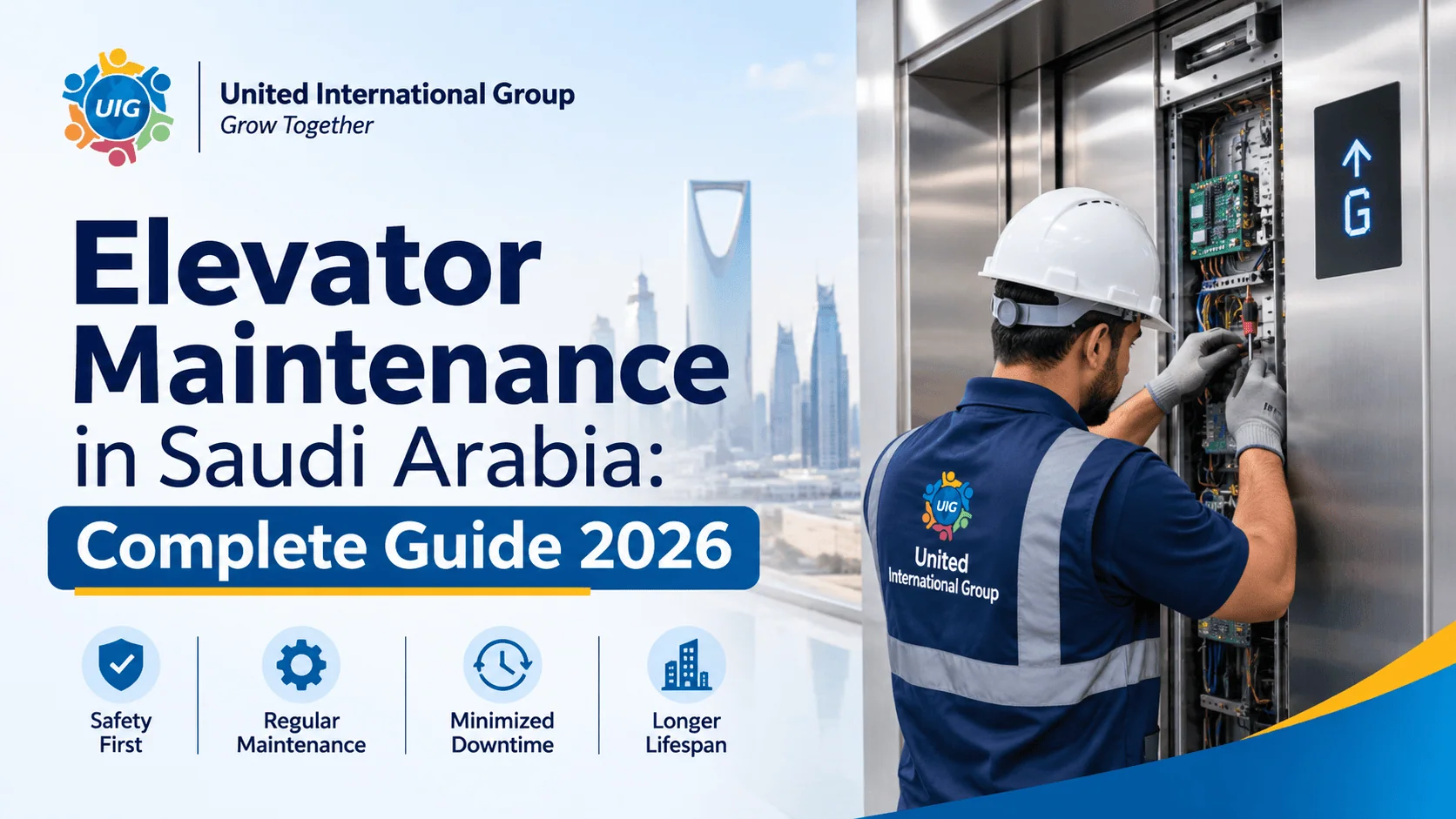
Elevator maintenance is the scheduled inspection, cleaning, lubrication and repair that keeps a lift safe and compliant. For most commercial buildings, that means a service visit every month, a deeper check every quarter and a full inspection with load testing once a year. This is usually covered by a maintenance agreement with a fixed annual fee.
This guide covers elevator maintenance in Saudi Arabia: the schedule, a working checklist, contract types, cost drivers and how to choose a provider in Riyadh, Jeddah or Jubail.
What Is Elevator Maintenance?
Elevator maintenance is preventive servicing of every part that moves, brakes, senses or controls the lift. It covers the machine, ropes or hydraulics, doors, safety circuits, controller and cab.
The goal is simple: find a worn part before it becomes a breakdown. A door roller costs little. A door failure that traps passengers during peak hour costs a lot more, in downtime and in complaints.
It also applies to escalators and moving walkways. Many mall and airport sites treat elevator and escalator maintenance as a single contract.
How Often Should Elevator Maintenance Be Performed?
Most commercial elevators need a service visit every month. High-traffic buildings such as hospitals, malls and towers often need more frequent attention. Here is the usual rhythm:
| Frequency | What gets done |
| Daily / weekly | Clean door sills and tracks, check cab lighting, emergency light and door operation |
| Monthly | Lubricate guides and door tracks, test door sensors, alarm and intercom, check ride quality |
| Quarterly | Inspect ropes, pulleys, brakes and safety circuits; check machine room temperature and ventilation |
| Annually | Full electrical and structural check, load and safety testing, oil and gear checks, controller diagnostics |
The daily and weekly items are usually done by building staff or the FM team. The rest needs a qualified lift technician.
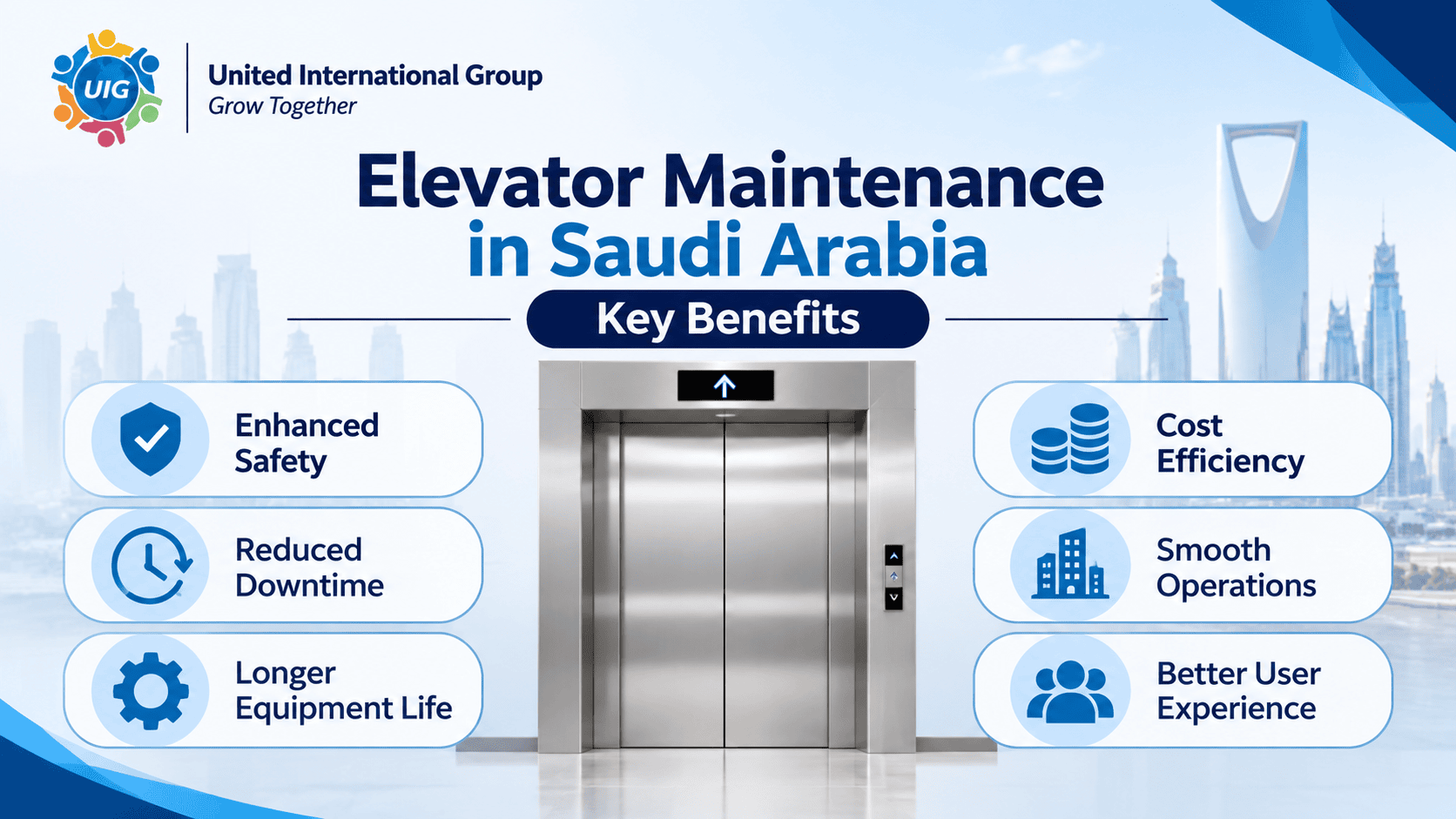
Elevator Maintenance Checklist
Use this when you review a service report. If a visit doesn’t cover most of it, ask why.
- Doors: rollers, sills, interlocks and sensors. Door faults cause the largest share of callouts.
- Machine and drive: noise, vibration, oil level, brake wear
- Ropes or hydraulics: rope condition and tension, or oil leaks and pump temperature
- Safety devices: governor, buffers, limit switches, emergency stop
- Controller: fault logs, software and parameter checks
- Pit and shaft: cleanliness, water ingress, lighting
- Cab: alarm, intercom, emergency lighting, ventilation
- Machine room: cooling and ventilation (more on this below)
Always ask for a signed report after each visit. No report means no record, and that causes trouble at inspection time.
Need a lift service schedule built around your building? Talk to UIG’s maintenance team →
Why Saudi Conditions Change the Plan
Generic checklists come from cooler, cleaner markets. In Saudi Arabia, three things push the plan harder:
- Heat: Machine rooms run hot. Overheating drives and motors are among the most common faults. Check the ventilation or cooling quarterly, not annually.
- Dust and sand: Fine dust gets into door tracks, sensors and controllers. Door tracks in Riyadh buildings need cleaning more often than the manual suggests.
- Coastal humidity: In Jeddah and Jubail, moisture and salt air speed up corrosion in pits, shafts and electrical parts.
Usage matters too. Towers, hospitals and malls have heavy traffic and peak surges. Vision 2030 construction has also added a large number of new high-rise lifts, so the maintenance demand is growing with the skyline.
On rules: lifts in the Kingdom are expected to meet Saudi Building Code requirements, and municipal authorities oversee inspection. Check current requirements with your municipality before signing any agreement. You can start with the Saudi Building Code National Committee.
Elevator Maintenance Agreements Compared
An elevator maintenance agreement (often called an AMC) is a contract where a provider services your lifts on a set schedule for a fixed fee. Most Saudi contracts fall into one of three types.
| Type | What’s included | Best for |
| Comprehensive | Scheduled servicing plus repairs and most parts | Towers, hospitals, buildings that want predictable cost |
| Non-comprehensive | Scheduled servicing only. Parts and repairs billed separately | Newer lifts under warranty or low usage |
| On-call / breakdown | Callout only, no routine visits | Rarely a good idea for commercial buildings |
The cheapest quote is often a non-comprehensive one. It looks fine until a drive board or controller fails and the invoice lands.
Whatever you choose, get these in writing:
- Visit frequency and response time
- Emergency entrapment response time
- What counts as a “major part”
- Exclusions, such as vandalism or water damage
- Reporting format and renewal terms
For more on setting measurable terms, see our guide to FM SLAs and KPIs.
How Much Does Elevator Maintenance Cost?
There is no single price, but the elevator maintenance cost per year depends on a short list of factors:
- Lift type (traction, hydraulic, machine-room-less) and age
- Number of floors and number of lifts
- Traffic and hours of use
- Agreement type (comprehensive costs more upfront)
- Response-time commitments, such as 24/7 emergency cover
- Condition at handover: older lifts may need repair before a contract starts
Ask every provider to price the same scope. Otherwise you’re comparing different contracts, not different prices.
Repair, Modernize or Replace?
Repair is fine when faults are isolated. Modernization makes sense when breakdowns repeat, parts are hard to source or the controller is obsolete. Many lifts are modernized at roughly 20 to 25 years, though condition matters more than age.
Replacement of an entire lift is a major capital cost that varies widely by lift type, height and specification. Get a condition survey first. It often shows that replacing the controller and door equipment gives you most of the benefit at a fraction of the cost.
How to Choose an Elevator Maintenance Provider
If you’ve searched “elevator maintenance companies near me”, you’ve seen how many options there are. Filter them like this:
- Experience with your lift brand. Multi-brand support matters if you have mixed equipment.
- Local response. Ask how fast a technician reaches Riyadh, Jeddah or Jubail sites, not just the average.
- Spare parts access. Ask where stock is held.
- Documentation. Service logs, inspection records and digital reporting.
- Integration with your FM setup. One provider handling lifts, HVAC, electrical and fire systems means fewer handoffs.
That last point is where UIG fits. Since 2011, United International Group has delivered 425+ projects for 250+ corporate clients across Saudi Arabia, including MEP maintenance that keeps vertical transport, HVAC and electrical systems under one accountable team. If you manage multiple sites, see how integrated facility management reduces vendor sprawl.
Planning a lift maintenance contract for 2026? Request a quote from UIG →
Conclusion
Good elevator maintenance in Saudi Arabia comes down to four things: a regular schedule, a clear checklist, the right agreement type and a provider who responds fast. Heat, dust and coastal humidity make this more important here than in most markets.
If you’re comparing contracts or reviewing a current one, UIG can help. We’ve served Saudi clients since 2011 and completed 425+ projects, with teams supporting sites in Riyadh, Jeddah and Jubail.
Contact UIG for a lift maintenance quote →
Frequently Asked Questions
How often should elevator maintenance be performed?
Monthly for most commercial lifts, with deeper quarterly checks and a full annual inspection. Heavy-use buildings may need more frequent visits.
What is elevator maintenance?
It is the regular inspection, cleaning, lubrication and repair of a lift’s mechanical, electrical and safety parts to keep it safe, reliable and compliant.
What is an elevator maintenance agreement?
A contract where a provider services your lifts on a fixed schedule for a set fee. It states visit frequency, response times, parts coverage and exclusions.
How much does elevator maintenance cost?
It depends on lift type, age, floors, traffic and contract type. Comprehensive agreements cost more upfront but cap repair spend. Request a quote based on your specific lifts.
How often do elevators need to be modernized?
Commonly every 20 to 25 years, or sooner if breakdowns repeat, parts are obsolete or the controller is outdated.
How much does it cost to replace an entire elevator?
Cost varies widely by lift type, travel height and specification. A condition survey will tell you whether full replacement or a partial upgrade makes sense.
How does an elevator control system work?
The controller reads button calls, decides which car to send, and signals the drive to move and the doors to open or close. A separate safety circuit stops the lift if something goes wrong.
Do escalators need the same maintenance?
Yes, on a similar schedule. Combs, steps, handrails and drive chains wear and need regular inspection. Many sites bundle elevator and escalator maintenance in one contract.