A facility management (FM) contract works when it has six things: a clear scope of services, SLAs with response and resolution times, KPIs that measure results, penalties and incentives, reporting and audit rights, and compliance with Saudi regulations. Most client-provider disputes trace back to one of these being vague.
This guide explains FM SLAs and KPIs in plain terms. You’ll see what each one does, which ones to include, and how to write them into a Saudi FM contract that holds up in Riyadh, Jeddah, and Jubail.
FM SLAs and KPIs: What’s the Difference?
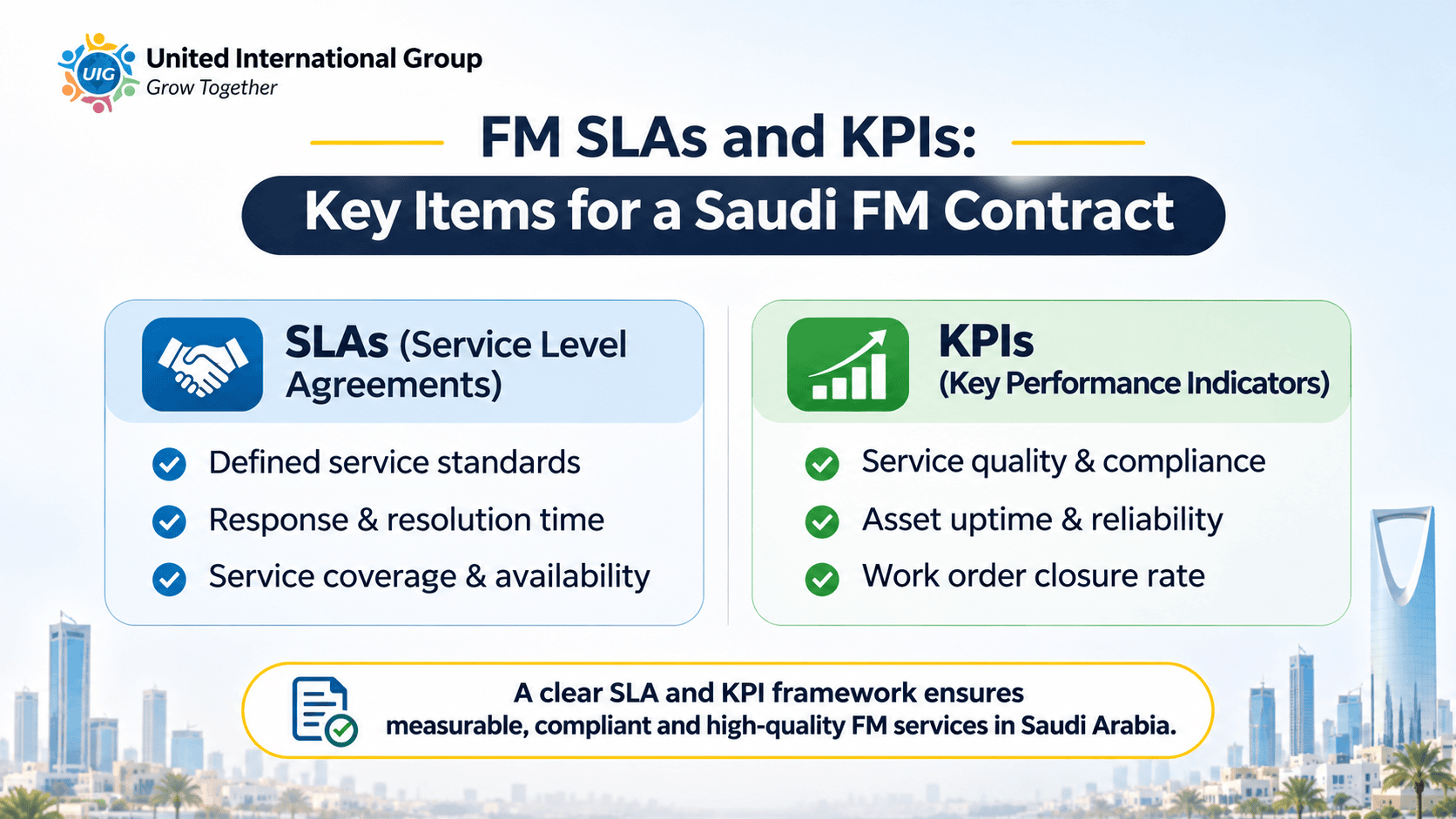
An SLA is the promise. A KPI is the scorecard.
An SLA (service level agreement) states what the provider will do and how fast. A KPI (key performance indicator) shows how well the provider performs over time.
| SLA | KPI | |
| Question it answers | What will be delivered, and by when? | How are we performing overall? |
| Example | AC failure in an occupied area fixed within 8 hours | 95% of reactive jobs closed within SLA each month |
| Used for | Daily service and penalties | Monthly reviews and renewal decisions |
The SLA says 8 hours. The KPI tells you how often it actually happened.
What Are the Key Components of a Facility Management Contract?
Eight factors decide whether a contract is enforceable or just a nice document.
Factor 1: Scope of Services
List every service by name, location, and frequency. “General maintenance” is not a scope.
A comprehensive facility management agreement typically covers:
- Hard services: MEP maintenance, HVAC, fire fighting systems, plumbing, electrical, lifts
- Soft services: cleaning, landscaping, pest control, waste management, security, reception
- Workforce solutions: technicians, supervisors, and support staff supplied under the contract
An integrated facility management contract bundles these under one agreement and one accountable manager. A facility management service contract usually covers a single service, such as cleaning only.
| Integrated FM contract | Single-service contract | |
| Accountability | One provider | One per service |
| Coordination | Handled by the provider | Handled by you |
| Cost visibility | One consolidated invoice | Several invoices |
| Best for | Towers, campuses, industrial sites | Small or simple sites |
If you manage more than two service lines, the coordination you save usually outweighs the premium.
Factor 2: Asset Register and Baseline Condition
Record every asset (chillers, pumps, fire panels, lifts) and its condition on day one. Without this, a failed chiller in month three becomes an argument about who broke it.
A joint baseline survey before handover takes a few weeks. It saves months of disputes.
Factor 3: SLAs by Priority
Group faults by urgency and set response and resolution times for each. These are starting points; adjust them to your site:
| Priority | Example | Response | Resolution |
| P1 Emergency | Fire alarm fault, lift entrapment, chiller failure in a critical area | 15–30 min | Make safe in 4 hrs |
| P2 Urgent | AC failure in an occupied area | 1 hr | 8 hrs |
| P3 Routine | Lighting, minor plumbing | 4 hrs | 3 working days |
| P4 Planned | Cosmetic repairs | 24 hrs | 7 days |
Define when the clock starts (ticket logged) and stops (client confirms the fix). Skip this and every missed target turns into a debate.
Factor 4: KPIs
Pick 8 to 12 KPIs. More than that and nobody reads the report. Good ones to start with:
- Planned preventive maintenance (PPM) completion rate
- SLA compliance rate
- First-time fix rate
- Repeat callouts on the same fault
- Helpdesk answer time
- Fire system test completion against schedule
- Cleaning audit scores
- Occupant satisfaction
Targets of 95% on PPM and SLA compliance are a common opening position. Treat them as negotiation anchors, not industry rules.
Drafting a contract for a Riyadh, Jeddah, or Jubail site? UIG can review your scope, SLAs, and KPIs before you sign. Request a contract review
Factor 5: Service Credits and Incentives
Tie missed SLAs to service credits, meaning a deduction from the monthly fee. Set a cap, agree a cure period, and define what counts as a repeat failure.
Penalties alone breed defensive behaviour. Add a modest incentive for sustained performance above target and you’ll get a provider who fixes root causes instead of symptoms.
Factor 6: Reporting, CAFM, and Audit Rights
Require a monthly report built from your CAFM system (computer-aided facility management software), not a manually assembled spreadsheet. Include audit rights so you can inspect work orders, PPM records, and staffing on request.
Factor 7: Saudi Compliance and Manpower
This is where a Saudi FM contract differs from a generic template. Cover:
- Saudization (Nitaqat) obligations under the Ministry of Human Resources and Social Development
- Wage Protection System (WPS) and GOSI compliance for all contract staff
- Civil Defense fire safety requirements and inspection certificates
- Maintenance obligations under the Saudi Building Code
- Insurance, HSE standards, and incident reporting
Climate and location matter too. Riyadh’s summer peak loads put chillers under heavy stress, so tighten AC SLAs from May to September. Coastal humidity in Jeddah accelerates corrosion on MEP equipment. Jubail’s industrial setting calls for stricter HSE and dust-control provisions.
Factor 8: Term, Pricing, and Exit
Most FM contracts run one to three years with renewal options. Choose a pricing model (fixed fee, cost-plus, or per-unit) and state how variations are priced. Add exit and handover clauses: asset records, keys, manuals, and a transition period.
Where Can You Find Reputable Facility Management Companies in Riyadh?
Start with a shortlist from your own network, industry bodies, and government or corporate tender portals. Then verify each company before you invite it to tender.
Check for:
- Valid commercial registration and relevant licences
- ISO 41001 (facility management systems) or equivalent certification
- References from buildings similar to yours in size and use
- In-house technicians, not just subcontracted labour
- Offices or teams in Riyadh, Jeddah, and Jubail if you manage multiple sites
- A site visit and sample monthly report before award
UIG has served clients across Saudi Arabia since 2011, with 425+ projects completed and 250+ corporate clients. Ask any provider you shortlist, UIG included, for the same level of proof.
Five Mistakes That Weaken an FM Contract
- SLAs with no measurement method. If the contract doesn’t say how a metric is measured, it can’t be enforced.
- No baseline survey. Every old defect becomes the new provider’s problem, or yours.
- Too many KPIs. Twenty-five metrics means none get managed.
- Penalties without cure periods. Instant deductions push both sides into disputes instead of fixes.
- Ignoring seasonality. One flat SLA for the whole year ignores Riyadh’s summer.
Conclusion: Write FM SLAs and KPIs You Can Actually Enforce
Good FM SLAs and KPIs are specific, measurable, and tied to consequences. Define the scope, set priority-based response times, choose a short list of KPIs, add service credits with a cure period, and build in Saudi compliance from the start.
Whether you need an integrated facility management contract or a single-service agreement, UIG can help you structure it. With 425+ projects delivered since 2011, our team has seen where contracts hold up and where they fall apart.
Ready to tighten your FM contract? Contact UIG for a free scope and SLA review across Riyadh, Jeddah, and Jubail.
Frequently Asked Questions
1. What are the key components of a facility management contract?
A facility management contract should include a defined scope of services, an asset register, SLAs with response and resolution times, KPIs, service credits and incentives, reporting and audit rights, Saudi compliance obligations (Saudization, WPS, Civil Defense), and clear term, pricing, and exit clauses.
2. Where can I find reputable facility management companies operating in Riyadh?
Shortlist from referrals, industry bodies, and tender portals, then verify each company. Check commercial registration, ISO 41001 certification, references from similar buildings, in-house technicians, and Riyadh-based teams. Ask for a site visit and a sample monthly report before awarding the contract.
3. What are the typical services included in a comprehensive facility management agreement?
A comprehensive agreement covers hard services (MEP maintenance, HVAC, fire fighting, plumbing, electrical, lifts) and soft services (cleaning, landscaping, pest control, waste management, security, reception). Many also include workforce supply and CAFM-based reporting.
4. What is the difference between an SLA and a KPI in facility management?
An SLA is a commitment on what service is delivered and how fast, such as fixing an AC failure within 8 hours. A KPI measures overall performance over time, such as the percentage of jobs closed within SLA each month.
5. What is an integrated facility management contract?
An integrated facility management contract bundles hard services, soft services, and workforce under one agreement with one accountable provider. It differs from a facility management service contract, which usually covers one service line such as cleaning or security.
6. How many KPIs should a facility management service contract have?
Eight to twelve is practical. That’s enough to cover maintenance, response, quality, and satisfaction without overwhelming the monthly report. Every KPI needs a defined measurement method and a target.
7. What happens if an FM provider misses an SLA?
The contract should specify service credits, meaning deductions from the monthly fee, along with a cure period and a cap. Repeated failures can trigger escalation, a corrective action plan, or termination rights.
8. When should FM SLAs and KPIs be reviewed?
Review KPIs monthly and SLAs at least annually. Also review them after major changes such as new equipment, occupancy shifts, or seasonal peaks like Riyadh’s summer cooling period.