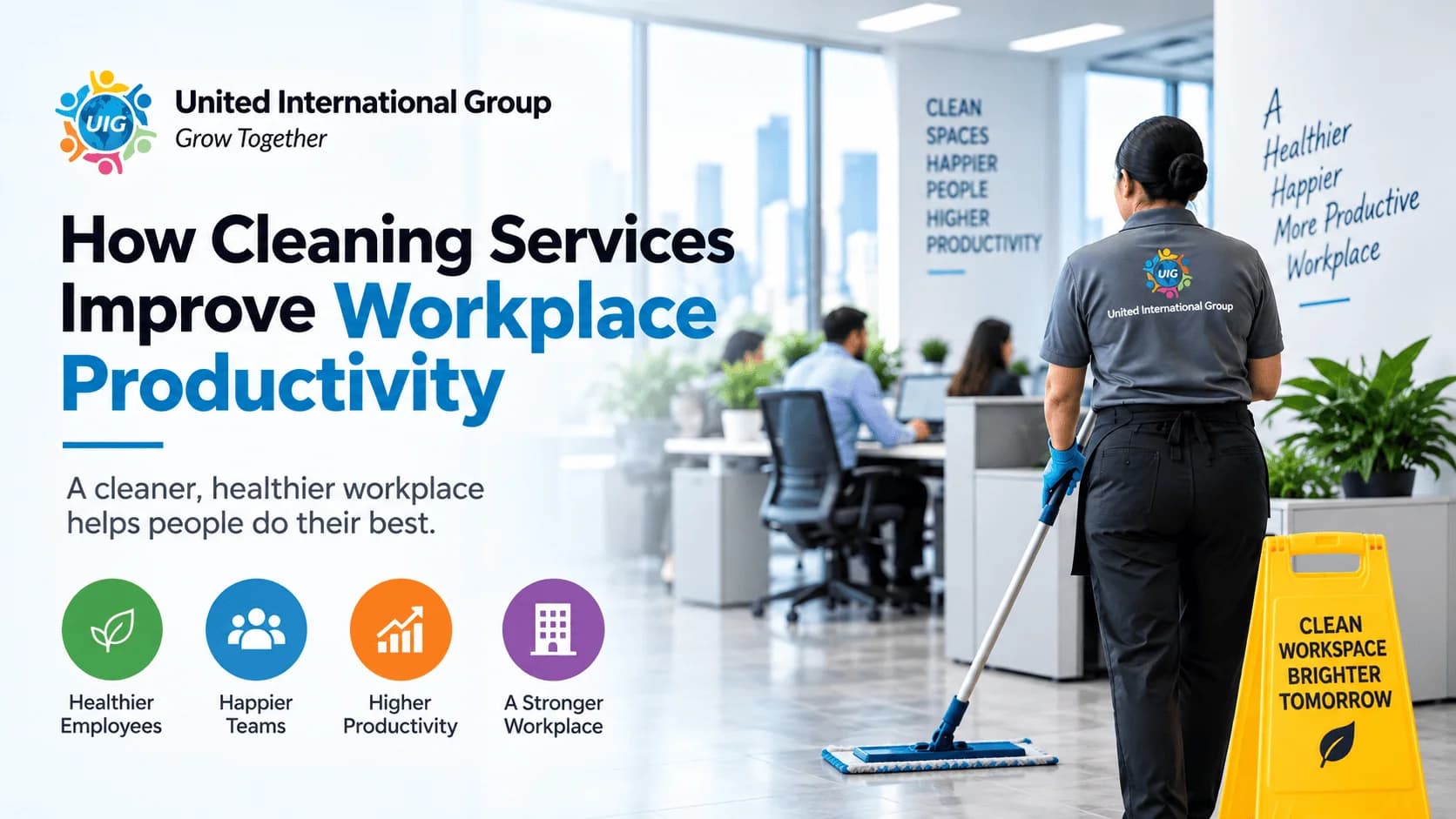
A workplace does not need to look dirty to start affecting productivity. Sometimes it is the meeting room that always smells closed. The washroom that employees avoid. The pantry counter that is never fully clean. The dusty reception area that makes visitors question the company before the meeting even starts.
That is why professional cleaning services matter. They do more than keep a space presentable. They help people work in a place that feels organized, safe, and cared for.
For offices, hospitals, malls, hotels, schools, warehouses, and industrial facilities in Saudi Arabia, cleaning is not a small maintenance task. It is part of how the workplace functions every day.
What Do Cleaning Services Have to Do With Productivity?
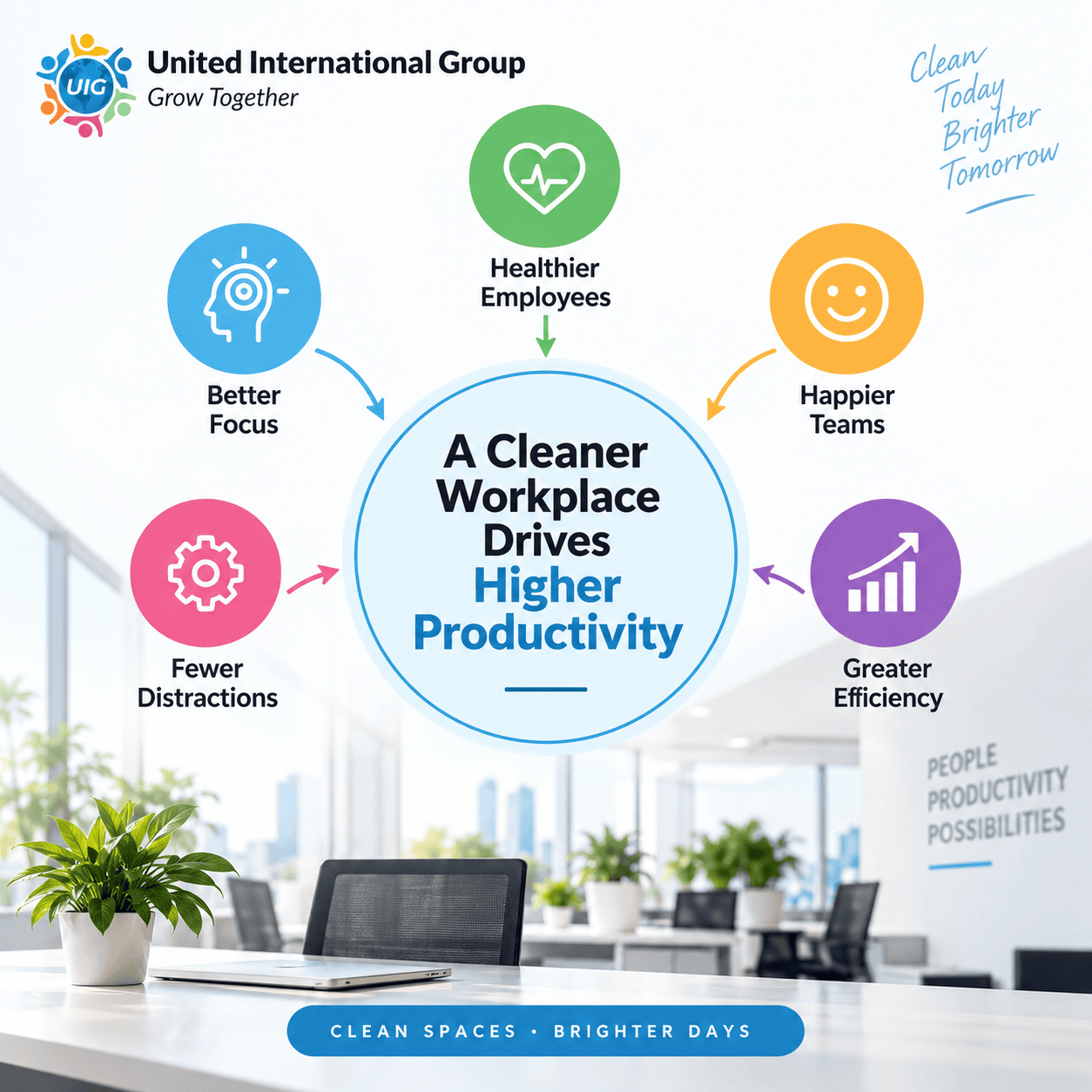
Cleaning services improve productivity by removing distractions, reducing hygiene risks, and making the workplace easier to use.
People work better in spaces that feel clean and controlled. They do not waste time complaining about the washroom, avoiding certain areas, wiping their own desks, or wondering whether a shared surface is hygienic.
A professionally cleaned workplace helps with:
- Better focus during work hours
- Fewer hygiene-related complaints
- More confidence in shared spaces
- Cleaner meeting rooms for clients
- Safer floors and walkways
- Better employee morale
- Stronger first impressions
This is especially important in high-footfall workplaces. A small office may only need daily cleaning and occasional deep cleaning. A hospital, mall, hotel, school, or industrial site needs a more serious cleaning plan because the risk and usage levels are higher.
Why Clean Workplaces Feel Easier to Work In
A clean workplace reduces friction.
That may sound simple, but it is a real operational issue. When a facility is not cleaned properly, small problems start taking attention away from actual work.
Employees notice things like:
- Dust on desks and screens
- Overflowing bins
- Sticky pantry counters
- Dirty glass doors
- Smelly washrooms
- Stained carpets
- Unclean lift buttons and handrails
- Cluttered common areas
None of these problems may stop work completely. But they create irritation. And when these issues happen every day, they affect how people feel about the workplace.
A clean office tells employees one thing clearly: this place is managed properly.
That matters. People are more likely to respect a space that is already cared for.
How Professional Cleaning Reduces Sick Days and Disruptions
Professional cleaning helps reduce the spread of germs by focusing on the areas people touch the most.
In most workplaces, the biggest hygiene risks are not hidden in corners. They are right in front of everyone.
High-touch areas include:
- Door handles
- Lift buttons
- Reception counters
- Meeting tables
- Light switches
- Pantry surfaces
- Washroom taps
- Handrails
- Shared phones
- Biometric machines
- Desk surfaces
When these areas are cleaned casually, germs spread easily. One sick employee can affect a whole team, especially in offices, schools, call centers, hospitals, and shared workspaces.
The CDC recommends paying special attention to high-touch surfaces, especially in busy facilities. The EPA also highlights that people spend most of their time indoors, which makes indoor cleanliness and air quality important for health and comfort.
For businesses, this is not only a health issue. It is a productivity issue.
When employees are absent, deadlines slow down. When teams are short-staffed, customer service suffers but when managers spend time handling complaints about facility hygiene, that is time taken away from core operations.
Professional Cleaning vs Basic In-House Cleaning
Basic cleaning can work for small spaces. But once a facility becomes larger, busier, or more customer-facing, informal cleaning usually starts to fail.
Here is the difference:
| Area | Basic In-House Cleaning | Professional Cleaning Services |
| Cleaning schedule | Often informal | Planned by area, risk, and footfall |
| Staff training | Limited | Trained for surfaces, hygiene, and safety |
| Supervision | Usually reactive | Regular checks and accountability |
| Equipment | Basic tools | Commercial-grade tools and materials |
| Deep cleaning | Often delayed | Scheduled properly |
| High-touch surfaces | Easily missed | Included in routine cleaning |
| Large sites | Difficult to manage | Easier to scale with manpower |
| Accountability | Unclear | Defined scope and service standards |
The main difference is consistency.
A professional cleaning company does not just “send cleaners.” It studies how the site is used, which areas get dirty fastest, what needs daily attention, and what should be deep cleaned at fixed intervals.
That is what makes cleaning reliable.
Which Areas Affect Productivity the Most?
The areas that affect workplace productivity most are the spaces employees use repeatedly throughout the day.
In an office, this means workstations, meeting rooms, pantry areas, washrooms, reception, corridors, and lifts.
In a warehouse, it means floors, loading areas, staff rooms, washrooms, storage areas, and safety pathways.
In a hotel, it includes guest-facing areas, back-of-house spaces, kitchens, corridors, washrooms, staff rooms, and service zones.
In a hospital or clinic, cleaning becomes even more sensitive because hygiene is linked to patient safety and infection control.
Every industry has different cleaning priorities. A corporate office in Riyadh does not need the same cleaning plan as an industrial facility in Jubail. A hotel in Jeddah does not need the same cleaning frequency as a warehouse in the Eastern Province.
That is why one-size-fits-all cleaning rarely works.
How Often Should a Workplace Be Cleaned?
A workplace should be cleaned based on footfall, operating hours, industry, and hygiene risk.
A simple schedule can look like this:
| Frequency | Cleaning Focus |
| Daily | Floors, desks, bins, washrooms, pantry, reception, high-touch points |
| Weekly | Glass, detailed dusting, upholstery checks, deeper floor cleaning |
| Monthly | Carpets, storage areas, vents, hard-to-reach corners |
| Quarterly | Full deep cleaning, facade cleaning, water tank cleaning, air duct cleaning, kitchen exhaust cleaning where required |
The higher the traffic, the more frequent the cleaning should be.
For example, a corporate office may need one main cleaning cycle per day. A mall may need continuous cleaning. A hospital may need strict cleaning routines throughout the day. A food service facility may need cleaning tied to hygiene and safety standards.
The best starting point is a site assessment. It shows where cleaning is working, where it is failing, and what frequency is actually needed.
What Good Cleaning Services Should Include
Good cleaning services should be planned, supervised, and suited to the facility.
A reliable cleaning plan usually includes:
- Daily surface cleaning
- Floor cleaning and maintenance
- Washroom cleaning
- Pantry and kitchen cleaning
- Waste collection
- High-touch surface cleaning
- Glass and partition cleaning
- Carpet and upholstery cleaning
- Deep cleaning
- Emergency cleaning support
- Periodic inspection
For larger facilities, cleaning may also connect with other facility management services such as pest control, waste management, MEP maintenance, landscaping, water tank cleaning, and air duct cleaning.
This is where an integrated facility management provider can be more useful than hiring separate vendors for every task.
How Cleaning Affects Brand Image
People judge a business by the condition of its space.
A client may not say anything about a dusty reception table or a stained meeting room carpet. But they notice it.
The same applies to employees. If the workplace feels neglected, they start feeling that the company is careless about their comfort. Over time, that affects morale.
Cleanliness supports brand image by improving:
- Client confidence
- Employee pride
- Visitor experience
- Tenant satisfaction
- Guest reviews
- Safety culture
- Facility reputation
For businesses in Saudi Arabia, especially in commercial real estate, healthcare, hospitality, retail, education, and industrial sectors, this matters. A clean facility does not guarantee trust, but a dirty one can lose it quickly.
What Should You Look for in a Cleaning Services Provider?
Choose a cleaning services provider that understands your industry, not just your square footage.
Before hiring, ask:
- Do they have experience with similar facilities?
- Can they handle your location and operating hours?
- Do they provide trained cleaning staff?
- Is there a supervisor or account manager?
- Are high-touch points included in the routine?
- Can they support emergency cleaning?
- Can they manage multiple sites?
- Do they offer related facility management services?
United International Group has been serving clients since 2011 as a facility management services provider in Saudi Arabia. The company supports businesses across Jeddah, Riyadh, Jubail, and the Eastern Province with cleaning and integrated facility management services.
That experience matters because cleaning rarely works in isolation. A facility may also need pest control, waste management, maintenance, landscaping, water tank cleaning, or air duct cleaning. When one provider can manage these connected services, the workplace becomes easier to control.
Conclusion
Cleaning services have a direct impact on workplace productivity.
A clean workplace helps employees focus, reduces hygiene risks, improves comfort, protects brand image, and keeps daily operations running smoothly. It also shows employees, clients, and visitors that the facility is being managed with care.
For businesses in Saudi Arabia, cleaning should not be treated as an afterthought. It should be part of a larger facility management strategy.
If your workplace needs more reliable cleaning, better supervision, or a complete facility management partner, United International Group can help you build a cleaner, safer, and more productive environment.
Contact United International Group today to request a facility assessment or cleaning services proposal for your workplace.
Frequently Asked Questions
Q. What are professional cleaning services?
Professional cleaning services are planned cleaning solutions for offices, hospitals, hotels, malls, warehouses, schools, and other facilities. They include daily cleaning, deep cleaning, high-touch surface cleaning, floor care, washroom cleaning, and waste handling.
Q. Why do cleaning services improve workplace productivity?
Cleaning services improve productivity by reducing distractions, improving hygiene, lowering complaints, and creating a workplace where employees can focus comfortably.
Q. How often should an office be professionally cleaned?
Most offices should be cleaned daily. High-touch areas such as door handles, lift buttons, pantry counters, and washrooms may need cleaning more than once a day depending on footfall.
Q. Which workplace areas need the most cleaning?
Washrooms, pantry areas, meeting rooms, workstations, reception areas, floors, lift buttons, door handles, handrails, and shared equipment need the most cleaning attention.
Q. When should a business hire professional cleaning services?
A business should hire professional cleaning services when cleaning quality becomes inconsistent, the facility has high footfall, employees complain about hygiene, or the space needs regular supervision and deep cleaning.
Q. How does workplace cleaning affect employee health?
Workplace cleaning helps reduce dust, germs, allergens, and contamination on shared surfaces. This can lower hygiene-related disruptions and create a healthier working environment.
Q. Are cleaning services part of facility management?
Yes. Cleaning services are a core part of facility management because they support hygiene, safety, employee experience, asset protection, and daily operations.
Q. Which industries need professional cleaning services most?
Healthcare, hospitality, corporate offices, malls, schools, universities, warehouses, factories, government buildings, and food service facilities need professional cleaning services regularly.