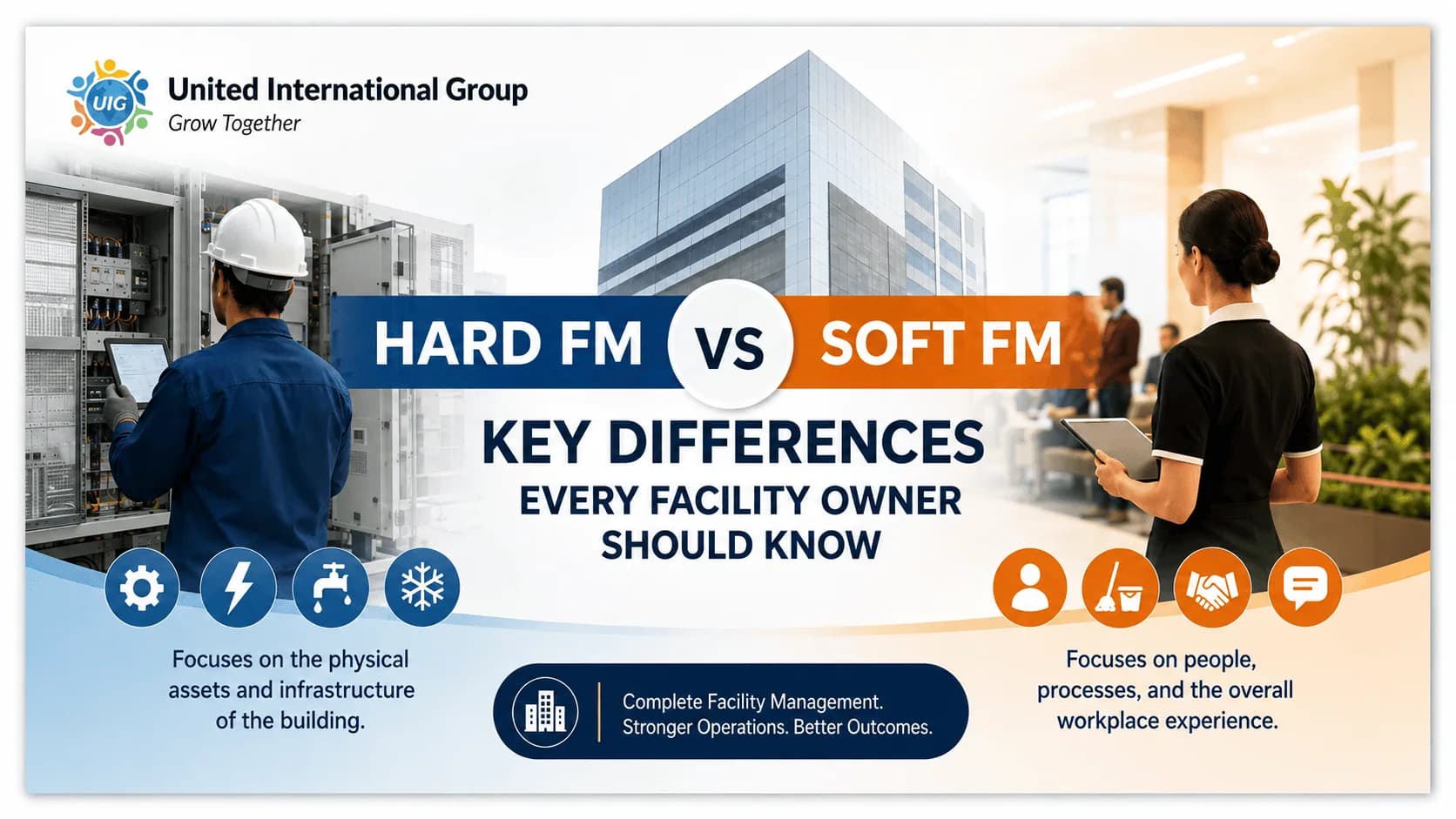
Facility management is no longer just about keeping a building clean or fixing equipment after it fails. For commercial buildings, hospitals, hotels, warehouses, offices, malls, schools, and industrial facilities, the real question is: who is protecting the asset, the people, and the daily operation? That is where understanding Hard FM vs Soft FM becomes important.
Hard FM covers the physical systems that keep a building safe and operational, such as HVAC, electrical, plumbing, fire systems, elevators, and mechanical equipment. Soft FM covers people-facing services such as cleaning, security, landscaping, pest control, waste management, reception support, and hygiene.
When both work together, facilities run smoothly. When one is ignored, costs rise, compliance risks increase, and the user experience suffers.
What Is Hard FM?
Hard FM means the technical and physical maintenance of a building’s fixed assets. Organizations can also use the ISO 41001:2018 facility management standard as a framework for establishing an effective FM management system.
These are the systems that are usually connected to safety, compliance, infrastructure, and business continuity. If Hard FM fails, the building may become unsafe, uncomfortable, non-compliant, or even temporarily unusable.
Common Hard FM services include:
- HVAC maintenance
- Electrical maintenance
- Plumbing systems
- MEP maintenance
- Fire fighting system inspection and maintenance
- Elevator installation and maintenance
- Building automation systems
- Industrial automation and storage systems
- Civil works and technical repairs
- Preventive and corrective maintenance
- Energy and asset performance monitoring
A simple example: if an office tower in Jeddah has poor HVAC maintenance, employees may experience discomfort, equipment rooms may overheat, energy bills may rise, and tenants may complain. That is a Hard FM issue because it affects the building’s core operating systems.
What Is Soft FM?
Soft FM means the non-technical services that improve the cleanliness, safety, comfort, appearance, and day-to-day experience of a facility.
These services may not always be part of the building structure, but they directly affect how people feel inside the space. Soft FM is especially important in customer-facing environments such as hotels, malls, healthcare facilities, schools, offices, showrooms, and restaurants.
Common Soft FM services include:
- Cleaning services
- Security services
- Pest control
- Landscaping
- Waste management
- Reception and front-of-house support
- Workforce solutions
- Event support
- Hygiene management
- Janitorial support
- Facility support staff
For example, a retail showroom may have perfect lighting, air conditioning, and electrical systems, but if the floors are dirty, washrooms are poorly maintained, pest control is weak, and waste is not managed properly, the customer experience will still suffer. That is a Soft FM failure.
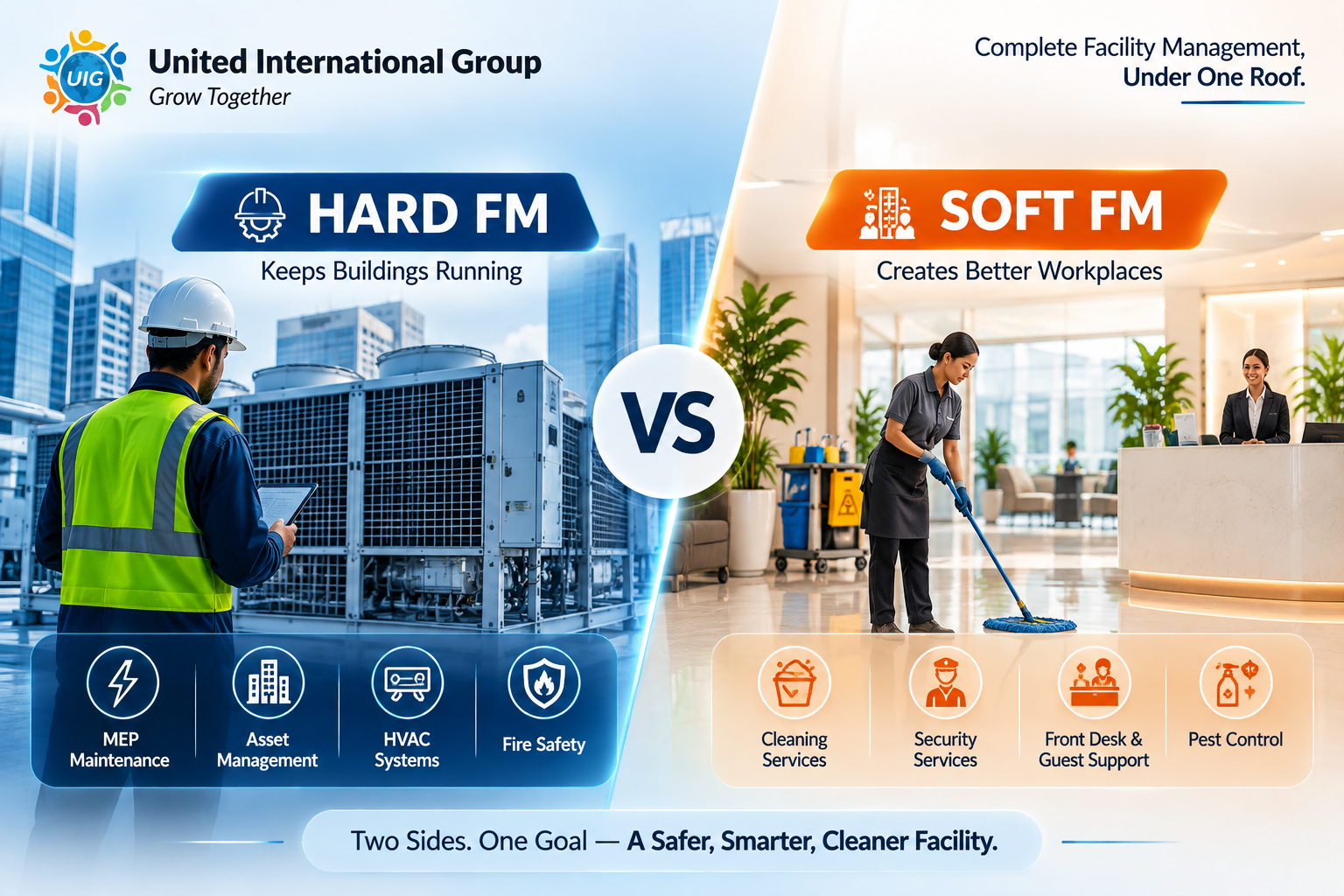
Hard FM vs Soft FM: Key Differences
Hard FM and Soft FM both support the same goal: a safe, efficient, and well-managed facility. The difference lies in what they manage.
| Factor | Hard FM | Soft FM |
| Main focus | Building systems and infrastructure | People, cleanliness, comfort, and daily support |
| Examples | HVAC, MEP, fire systems, elevators, plumbing, electrical | Cleaning, security, pest control, landscaping, waste management |
| Risk if ignored | Downtime, safety issues, compliance failures, asset damage | Poor hygiene, weak user experience, complaints, reputational damage |
| Skill type | Technical engineers, electricians, MEP teams, certified technicians | Cleaning staff, security teams, supervisors, support staff |
| Frequency | Scheduled maintenance, inspections, reactive repairs | Daily, weekly, shift-based, seasonal, or event-based |
| Business impact | Protects assets and operational continuity | Improves occupant satisfaction and brand perception |
| Compliance link | Strongly linked to safety, civil defense, and technical standards | Linked to hygiene, safety, workplace standards, and customer experience |
The easiest way to remember it is this:
Hard FM keeps the building working. Soft FM keeps the building usable, clean, safe, and pleasant.
Why Both Hard FM and Soft FM Matter in Saudi Arabia
Saudi Arabia’s commercial, hospitality, logistics, healthcare, education, and industrial sectors are growing quickly. With this growth, facilities are becoming larger, more complex, and more service-sensitive.
A modern facility in Jeddah, Riyadh, or the Eastern Province may include HVAC systems, elevators, fire fighting systems, access control, automation, commercial kitchens, storage areas, digital signage, video walls, data rooms, landscaped outdoor areas, and high-footfall public spaces.
This creates two operational needs:
- Technical reliability through Hard FM
- Daily service quality through Soft FM
For example, in a mall or showroom, digital signage and commercial display systems need stable electrical support, cooling, preventive maintenance, and safe installation. That is Hard FM. But the same space also needs clean floors, clear waste disposal, pest prevention, security presence, and polished visitor areas. That is Soft FM.
One without the other creates gaps.
Practical Examples of Hard FM and Soft FM Working Together
1. Corporate Offices
Hard FM keeps HVAC, lighting, electrical systems, plumbing, and elevators working. Soft FM keeps the space clean, secure, hygienic, and presentable for employees and visitors.
When both are managed well, productivity improves and complaints reduce.
2. Healthcare Facilities
Hard FM supports critical systems such as ventilation, electrical reliability, plumbing, elevators, fire safety, and emergency systems. Soft FM supports cleaning, disinfection, waste segregation, pest control, and patient-facing support.
In healthcare, the margin for error is small. A weak FM strategy can affect safety, hygiene, and patient trust.
3. Hotels and Resorts
Hard FM protects guest comfort through air conditioning, hot water, lighting, elevators, fire systems, and room maintenance. Soft FM supports housekeeping, landscaping, pest control, waste handling, security, and event support.
For hospitality brands, FM directly affects guest reviews and repeat bookings.
4. Warehouses and Industrial Facilities
Hard FM manages mechanical systems, electrical infrastructure, automation, fire systems, storage equipment, loading areas, and asset maintenance. Soft FM manages cleaning, pest control, waste, security, workforce support, and site discipline.
For industrial operations, good FM reduces downtime and supports safety compliance.
5. Retail and Showrooms
Hard FM supports lighting, HVAC, electrical systems, escalators, display technology, digital signage, video walls, and fire safety. Soft FM supports cleanliness, security, landscaping, waste, washroom hygiene, and customer-facing support.
This is where facility management becomes part of the customer experience.
Which Is More Important: Hard FM or Soft FM?
Hard FM and Soft FM are equally important, but their impact is different.
Hard FM is usually more compliance-critical because it protects the physical infrastructure and safety systems of a building. In Saudi Arabia, this includes compliance considerations related to fire prevention and protection under the Civil Defense requirements and Saudi Building Code. If electrical systems, fire fighting systems, elevators, or HVAC fail, the impact can be immediate and serious.
Soft FM is more experience-critical because it affects how people interact with the space every day. Cleanliness, security, pest control, landscaping, and hygiene shape trust, comfort, and brand perception.
The best approach is not choosing one over the other. It is integrating both.
How Integrated Facility Management Solves the Gap
Integrated facility management brings Hard FM and Soft FM under one coordinated structure. Instead of managing separate vendors for cleaning, MEP, pest control, landscaping, fire systems, waste, and facility audits, businesses work with one accountable partner.
This helps reduce:
- Communication gaps
- Vendor overlap
- Delayed response times
- Inconsistent service quality
- Hidden operational costs
- Compliance risks
- Poor reporting visibility
For multi-site companies, this matters even more. A business with offices in Jeddah, Riyadh, and Jubail needs consistent standards, clear SLAs, trained teams, and reliable escalation.
UIG has been serving clients since 2011 and provides 14 integrated services across Saudi Arabia, including integrated facility management, cleaning, pest control, landscaping, MEP maintenance, fire fighting, elevator maintenance, waste management, IT and CAFM solutions, facility audits, workforce solutions, and project support.
Expert Insight: The Real Cost Is Usually in the Gaps
Many facility owners focus only on visible costs: cleaning contracts, repair bills, maintenance teams, or emergency callouts.
But the real cost often appears in the gaps between services.
For example:
- Cleaning teams notice a water leak but have no direct maintenance escalation.
- HVAC issues increase energy bills because preventive maintenance is delayed.
- Pest control fails because waste management is inconsistent.
- Fire systems are installed but not maintained properly.
- Security teams report issues, but there is no structured CAFM tracking.
- Multiple vendors blame each other instead of solving the problem.
This is why integrated FM is becoming more valuable. It connects people, assets, systems, reporting, and accountability.
When Should a Business Review Its FM Model?
A business should review its facility management model when service issues become frequent or costs become difficult to control.
Common warning signs include:
- Repeated HVAC, electrical, plumbing, or elevator issues
- Frequent tenant, guest, or employee complaints
- Poor cleaning consistency
- Pest problems despite regular treatment
- Rising emergency repair costs
- No clear asset maintenance history
- Weak vendor coordination
- Missed inspections or compliance concerns
- No digital reporting or CAFM visibility
- Facility teams reacting instead of planning
If these signs are present, the issue may not be one vendor. The issue may be the structure of the FM model itself.
How to Choose the Right FM Partner
Choosing the right facility management partner is not only about price. It is about operational reliability, compliance, responsiveness, and long-term value.
Look for an FM partner that can provide:
- Experience across different industries
- Strong Hard FM and Soft FM capabilities
- Preventive maintenance planning
- Trained and supervised teams
- 24/7 support for critical issues
- Clear SLAs and reporting
- Compliance with local regulations
- Facility audits and improvement plans
- Digital visibility through CAFM
- Ability to scale across multiple locations
UIG operates as a multi-service facility management provider headquartered in Jeddah, with operations across key regions in Saudi Arabia.
Conclusion: Hard FM vs Soft FM Comes Down to Asset Protection and Experience
Understanding Hard FM vs Soft FM helps business owners, facility managers, and operations leaders make better decisions about safety, compliance, cost control, and service quality.
Hard FM protects the building’s technical systems. Soft FM protects the people experience inside and around the building. Integrated facility management connects both, giving companies one structure, one accountable partner, and better control over daily operations.
For businesses in Jeddah, Riyadh, the Eastern Province, and across Saudi Arabia, UIG brings the experience, service range, and operational capability needed to manage facilities with confidence.
Looking for a facility management partner that can handle both Hard FM and Soft FM under one integrated service model? Contact UIG today to request a customized facility management proposal.
Frequently Asked Questions
1. What is the difference between Hard FM and Soft FM?
Hard FM manages the physical systems of a building, such as HVAC, electrical, plumbing, fire systems, and elevators. Soft FM manages people-facing services such as cleaning, security, landscaping, pest control, and waste management.
2. What are examples of Hard FM services?
Examples of Hard FM services include MEP maintenance, HVAC servicing, electrical repairs, plumbing, fire fighting system maintenance, elevator maintenance, building automation, and preventive asset maintenance.
3. What are examples of Soft FM services?
Examples of Soft FM services include cleaning, security, pest control, landscaping, waste management, reception support, housekeeping, event support, and workforce solutions.
4. Is cleaning a Hard FM or Soft FM service?
Cleaning is Soft FM service because it supports hygiene, comfort, appearance, and user experience rather than the fixed technical infrastructure of the building.
5. Is HVAC maintenance Hard FM or Soft FM?
HVAC maintenance is Hard FM because it involves the technical system that controls heating, ventilation, air conditioning, comfort, and indoor air quality.
6. Why do businesses need both Hard FM and Soft FM?
Businesses need both because Hard FM protects building systems and compliance, while Soft FM protects cleanliness, safety, comfort, and daily user experience. Together, they reduce risk and improve operational performance.
7. What is integrated facility management?
Integrated facility management means managing multiple facility services under one coordinated contract, team, SLA, and reporting structure. It improves accountability and reduces vendor management complexity.
8. Which industries need Hard FM and Soft FM?
Industries such as commercial real estate, hospitality, healthcare, education, retail, logistics, manufacturing, government, and food and beverage need both Hard FM and Soft FM.
9. When should a company outsource facility management?
A company should consider outsourcing FM when internal teams struggle with maintenance, compliance, cleaning quality, vendor coordination, emergency response, or multi-site consistency.